About this blog

Incoming BYTES
contains highly variable subject matter including commentary on the mundane, the extraordinary and even controversial issues. At Incoming BYTES
we want YOU to think...if you dare...

Followers

Showing posts with label heritage apples. Show all posts

Saturday, September 1, 2012

Apples Galore


"Surely the apple is the noblest of fruits.
                                                           -- Henry David Thoreau, Wild Apples

Interesting that here we are, September 1st--and after a strange, weird, and late spring, our apple trees are actually ahead of schedule.
  How can that be?   The earliest of our apples were two weeks earlier than usual, and  normally late-season apples are now ready-- early. The crop?  Better than average.

 See?  Apples by the gazillions.  Some 50 gallons of  Haralson Red apples were picked today from a single tree.   The Harelson Red is a good multi-purpose apple.  A few late foundling grapes were rescued from the squirrels while we were out and about too.


Haralson Red Apples and a few foundling Concord grapes too


 We also picked the Sweet Sixteen apples.  A big, sweet apple that keeps well,  the Sweet Sixteen is a promising apple for our geographic area. Our Sweet Sixteen tree was stressed by weird spring conditions, and although the leaves were smaller than usual, the apples were bigger than in previous years .  See these?  They're huge!


Sweet Sixteen Apples--A big, sweet, crisp apple.


 It is strange the Sweet Sixteens  certainly were far bigger than usual. Check this one out!  The quality and size of the fruit was no less than amazing this year.  Not too shabby! 
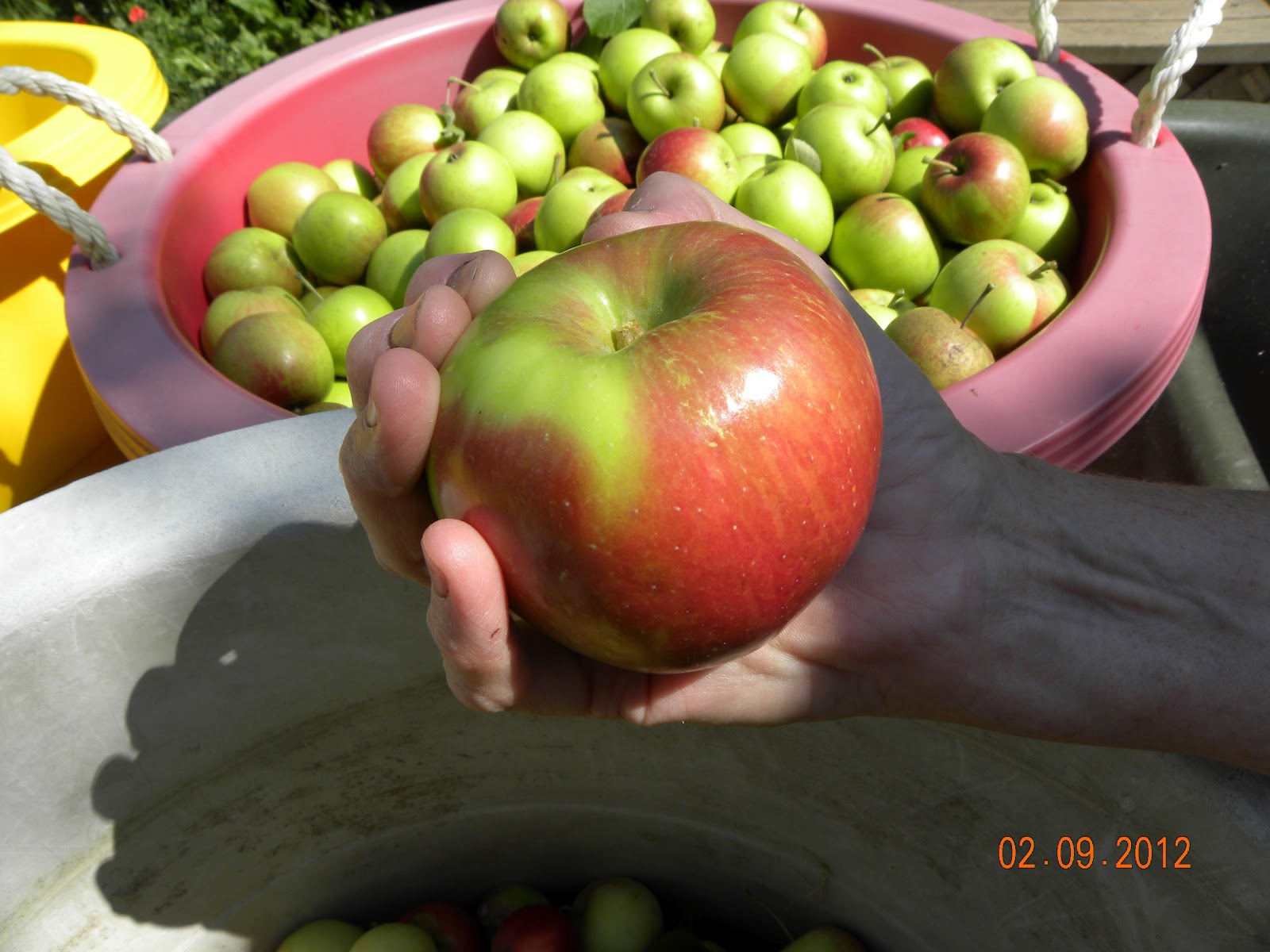


A perfect Sweet Sixteen Apple
 Luke apples are moderately late, moderately tart, and fortunately, also a very good keeping apple.  Lukes can be stored for many months.   An apple with less juice, they are excellent for pastry, drying, and making apple sauce. The Luke is a large apple, at times over 4" across, and the trees are prolific in good years.  We picked a bushel of these delicious apples this season.


Luke Apples--Huge.


Then there were the September Ruby apples. Not a long keeper, they are sweet, delicious, and a prolific producer. The September Ruby makes wonderful apple sauce or juice too, great for eating out of hand, but much like the earliest Norlands, do not store well for extended periods.

September Ruby Apples 2012


Experimental apples:  The WendyCrisp.   If we didn't mind a hungry bear chewing a few of the best, ---the 'WendyCrisp",  a new, snapping crisp and sweet apple, our apple-picking might have waited a few days.

  The bear attacking that special tree "encouraged" us to pick the rest of the apples in a hurry to avoid any further tree damage. That made me very cranky.


The beautiful WendyCrisp apple grew from a tiny wild apple tree sprout found in the wilds, ---and is now a producing tree. The WendyCrisp  ripens in September, bearing  brilliant red,   sweet, snapping-crispy and juicy apples with a wonderful flavor. They keep better than most.  The size of these apples appears to be medium-but some large individual apples have been noted, which offers great potential.  We have yet to use  thinning or enhanced pruning techniques to optimize apple size.


The WendyCrisp apple

Other apples worth  exploring for this difficult climate are the Spartan,  Pink Lady, and McIntosh.

A friend of mine also  has a Yellow Gala apple tree in production;  the apples are large, yellow-green, sweet, and very good tasting. It, too,  looks like a potential grafting project!

I am also looking for a heritage Winesap apple which is reportedly  a late-producing apple. Would the wonderful heritage Winesap grow and produce in NW Ontario?  We certainly won' t know until we try!

Is that Incoming I hear?


Photo credits:  Photographs in this post were all taken by the author.


Saturday, April 7, 2012

G is for Grafting

These big pin apple blossoms  produce tiny 1/4" sized apple

You, too can learn Grafting

 Have you dreamed about harvesting big, sweet  apples from that old crab apple tree in the back yard? You know, the one with perfect, beautiful snow-white apple blossoms, but offering only sour, tiny apples  birds won't even bother with?


Maybe the old farmer down the road mentioned you could graft it  ten years ago but you didn't want to look like a  city-slicker, so you didn't ask what he meant--and forgot all about it.  
Does your neighbour have a huge apple tree you admire, especially  when you are given a few crisp, ripe apples from it?   Perhaps  that 40-foot  tree was far too big for your yard anyway. It would also be safer to harvest  if it was only 10 feet high, wouldn't it?
 Maybe you deviously planted a couple of ripe, brown seeds from the wondrous gift  apples, grew a tree, waited ten years with your fingers crossed--but ended  up with a miserable  apple replica seemingly unrelated to the marvelous apples next door.
Why?  Apple trees grown from seed often produce fruit that bears no resemblance to fruit from the parent tree.  Apple trees grown from seed do not always grow 'true to type' and may be totally different.  Grafting is required to guarantee apples with the same characteristics.

That coveted tree may be  a unique heritage variety nobody except real old-timers have even heard of --so the  new, modern  garden center won't have one to sell you either.  |Isn't that frustrating? 
  How about picking  four different kinds of apples from  the same tree? Yes, you can change the  nature of your tree.  Add different varieties  to it, or, with time  and patience , change entirely the apple variety that is produced by your tree.  How?


A successful 5-month old wedge graft

 Such wonders are all achieved with the special process called  grafting.  Cuttings, called scions, which are small twigs or  branches of one variety are grafted on to an older existing tree, a small sprout, a  sapling, or even a basic rootstock of an entirely different variety.

If grafting is done skilfully at the right time of the year, a new tree can be successfully grown. 


 Surprise, --you can even grow a new heritage tree by grafting.
  Grafting cuttings from that heritage tree on to the right root stock can provide the same wonderful heritage apples from smaller trees -- if the scions are successfully grafted to dwarf rootstock.  Dwarf rootstock has been developed specifically to limit the height of any species grafted to them and in some cases, can also result in a  more hardy, disease-resistant tree.
 Can anyone graft? There are difficult  grafting methods, but in it's simplest form,   a clean wedge is carved on the lower end of a scion which is then carefully inserted into a matching appropriate "split" made in a cut-off sapling,  a suitably-located small branch  in the host tree  or suitably located on a healthy piece of root stock. You can also drill a hole in a tree trunk and insert a properly-prepared scion,  or carefully insert a simple 'bud' to install a new branch.

In all cases, regardless of the grafting method used, the cambium,  the 'green' layers under the bark in both scion and host--  must be matched perfectly and fitted  together tightly to ensure success.   The joining area must then be tightly sealed with waterproof tape,  'grafting wax' or other suitable sealant or material.  
Timing is important, but two essential rules must not be overlooked;  the cambium layers MUST be matched to fit tightly, and the  joint MUST  be airtight.
Grafting is usually conducted just  before buds begin to expand and grow, to take advantage of the initial flow of sap and spurt of growth in the spring. The scions themselves may be harvested from other trees when dormant,  in very late autumn or winter, and kept refrigerated until used.

The same graft in bloom


The picture here proves that grafting works. This is the same graft as shown aboveThe graft was successful,  and the blossoms show that mature scions were successfully chosen for this graft. You can see the black tape seal where the graft was made. 

Try grafting.  When your first graft actually grows and survives--or better yet, thrives and blossoms, like this one did,  you will be hooked on grafting for life.
You'll be a a grafter for life, and you will be picking those heritage apples you always wanted--from your own tree.


Then, -- how about those   roses, pears, cherries, nectarines, and peaches?  They can all be grafted....

 
Is that incoming I hear?


 The A to Z Blogger Challenge:  http://www.a-to-zchallenge.com/